
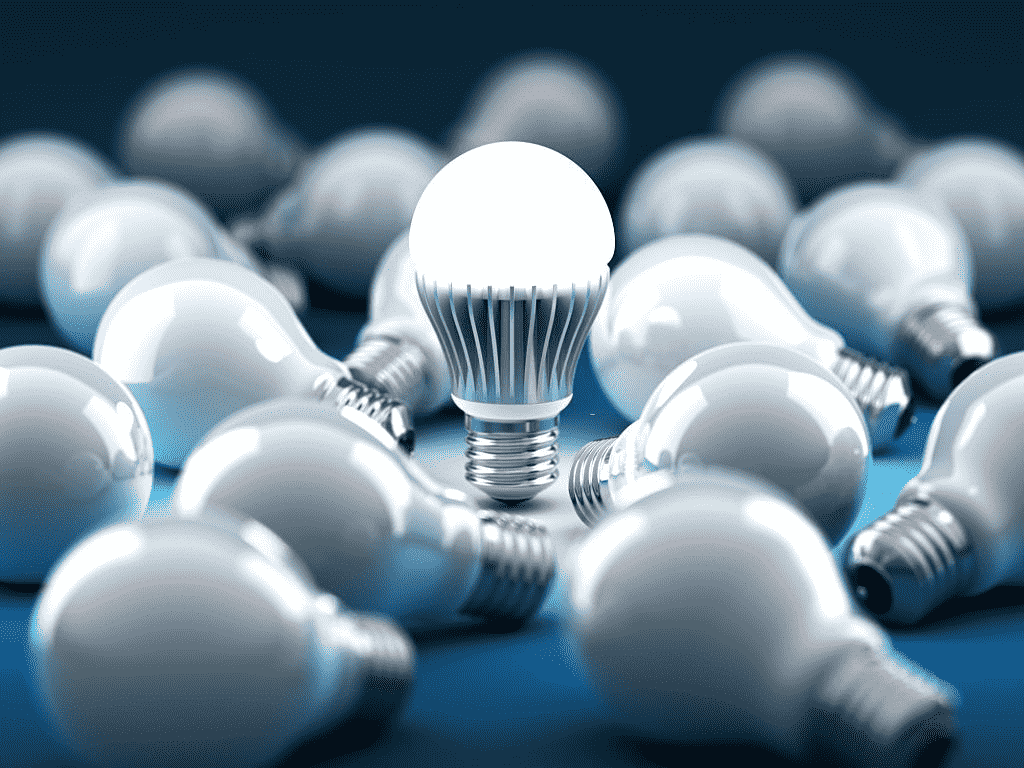
LED lighting is more than just a quick upgrade; it’s a fundamental shift in energy management for commercial and industrial operations across the United States. Sourced directly from official U.S. government energy data, this analysis provides practical insights into the massive energy and cost savings, as well as the significant environmental benefits, of transitioning to high-efficiency LED systems and controls.
1. The Energy and Cost Savings Analysis: A Practical Breakdown
LED technology fundamentally changes the financial model for business lighting. Data from the U.S. Department of Energy (DOE) and ENERGY STAR shows the clear advantage:
| Old Technology vs. LED | Energy Reduction | Lifespan Increase | Maintenance/Operations Savings |
| Incandescent Comparison | At least 75% less energy used (Source 1.2) | Up to 25 times longer lifespan (Source 1.2) | Substantial reduction in replacement costs and labor hours (Source 1.6) |
| Typical Commercial Buildings | Lighting consumes 17% of all electricity (Source 1.6) | Upgrading to LEDs can save 90% of the electricity used by the replaced bulb (Source 1.6) | LEDs last 15 times longer, leading to big financial savings on operations and maintenance (Source 1.6) |
Realized and Potential National Savings
The savings scale dramatically when applied across the entire U.S. commercial and industrial market.
- Current Savings: The transition to LEDs resulted in $14.7 billion in consumer cost savings in 2018 (Source 1.1).
- Future Potential: Widespread use of the most efficient, connected LED products could realize over 5 quadrillion Btu (quads) of annual energy savings, equivalent to about 20% of total building electricity use (Source 1.1).
- Grid Impact: By 2035, the annual energy savings from LED adoption could top 569 Terawatt-hours (TWh), which is comparable to the annual energy output of more than 92 large 1,000 MW power plants (Source 1.2).
The Life-Cycle Cost Advantage
Federal procurement standards emphasize Life Cycle Cost-Effectiveness for lighting purchases. This analysis shows that an efficient product is cost-effective when its lifetime energy savings (avoided costs) exceed any additional up-front cost.
The Federal Energy Management Program (FEMP) provides this clear financial example for a standard commercial luminaire:
| Model Type | Annual Energy Cost | Lifetime Energy Cost | Lifetime Cost Savings (vs. Less Efficient Model) |
| Best Available LED Model | $11 | $119 | Up to $161 per fixture (Source 1.7) |
To make the transition even more financially practical, businesses can leverage utility rebates and incentives, which often target commercial buildings and can offer savings up to $249 for qualified LED light fixtures (Source 1.6).
2. Industry-Specific Optimization through Smart Lighting
The greatest power optimization comes from pairing LEDs with Networked Lighting Controls (NLCs)—smart systems that utilize occupancy sensors, daylight harvesting, and dimming schedules.
| Sector | Primary Lighting Needs | Optimization Potential (LEDs + Controls) |
| Manufacturers & Industrial Facilities | High-bay and low-bay fixtures; long operating hours. | These fixtures are identified by the DOE as offering the greatest potential savings (Source 1.1). NLCs can dim or turn off lights in unstaffed areas or during down-time, leading to potential additional savings of 80% (Source 1.3). |
| Data Centers & Hospitals | Consistent, high-quality lighting; precise environmental control. | LEDs emit significantly less heat (only 10-20% of their energy as heat, compared to 80-90% for older bulbs) (Source 1.2). This reduces the load on cooling systems, saving energy in both the lighting and HVAC systems—critical for heat-sensitive facilities like data centers (Source 1.8). |
| Education Centers & Offices | Recessed downlights, task lighting, and linear fixtures. | LEDs are ideal for task lighting due to their directional nature (Source 1.2). NLCs allow for daylight harvesting, automatically dimming electric lights when natural light is sufficient, maintaining optimal lighting levels while saving energy. |
The combined power of LEDs and NLCs is estimated to shave peak electricity demand by over 37,000 megawatts (MW) by 2035, directly benefiting energy utilities by reducing stress on the power grid (Source 1.4).
3. Reducing the Carbon Footprint and Pollution
Replacing old lighting with LEDs contributes directly to a business’s environmental, social, and governance (ESG) goals and cuts its carbon footprint.
Carbon Emission Reduction
By reducing the demand for electricity, businesses are directly lowering the amount of fossil fuels burned by power plants. The projected annual energy savings of 569 TWh by 2035 is a massive step toward national carbon reduction. For the federal government, this transition is a key component of the goal to achieve net-zero operational emissions by 2050 (Source 1.3).
Pollution Mitigation
- Reduced Heat Output: Since LEDs produce very little heat, they decrease the demand on air conditioning, which in turn reduces the energy consumption and greenhouse gas emissions associated with building cooling (Source 1.2, 1.8).
- Extended Lifespan: The significantly longer lifespan of LEDs (up to 25 times that of incandescents) means far less waste material sent to landfills and a reduced environmental impact from manufacturing, shipping, and disposal (Source 1.2).
- Light Pollution: New outdoor LED luminaires are subject to standards that minimize light pollution while still maintaining safety and saving energy (Source 1.4).
By adopting LED lighting, commercial and industrial businesses in the U.S. are not just cutting their utility bills; they are actively investing in a smarter, more sustainable, and less carbon-intensive future.
Case Study:
Industrial ENERGY STAR LED Lighting Benefits:
Centers with ENERGY STAR LED Lighting
This case study models the likely outcomes for two hypothetical data centers, DC-A (Large, Colocation) and DC-B (Mid-size, Enterprise), both located in Washington State, following a comprehensive upgrade from legacy fluorescent (T8/T12) and metal halide lighting to Industrial ENERGY STAR Certified LED lighting with integrated Networked Lighting Controls (NLCs).
1. The Upgrade & Energy Context
| Detail | Data Center/ West Washington (Mid-size Enterprise) |
| Existing Lighting | T8 Fluorescent and some High-Intensity Discharge (HID). |
| Upgrade to | ENERGY STAR Certified Industrial LED Fixtures + Basic Occupancy Sensors. |
| Operating Hours | 24/7/365 (Data Halls) / 8-10 hrs/day (Offices/Common) |
| Electric Utility Rate | $0.10/kWh (Estimated average commercial rate, West WA) |
2. Impact on Power Usage and Carbon Footprint
In a data center, lighting-related power savings are doubly effective due to the cooling load. Less power consumed by lights means less heat generated, which in turn reduces the energy needed for the Computer Room Air Handlers (CRAHs) and chillers.
A. Power Usage (kWh) Optimization
- Direct Lighting Energy Reduction: LEDs typically consume 60% to 80% less energy than T8/T12 fixtures.
- Controls Multiplier: The addition of occupancy sensors and NLCs in data halls (where lights are often left on 24/7 for security/maintenance) can add an extra 20% to 40% in energy savings, as lights only turn on when a human is present.
- Cooling Energy Reduction: The decreased heat load translates to a PUE (Power Usage Effectiveness) benefit, where cooling energy is reduced by approximately $30\%$ of the lighting energy savings.
Total Energy Saved= Lighting Saving+ Colling Saving
B. Carbon Footprint Reduction (GHG Emissions)
Washington State’s electricity is generally cleaner than the national average, especially from utilities committed to the state’s Clean Energy Transformation Act (CETA), which mandates 100% clean electricity by 2045.
- GHG Emissions Factor (WA Average): While East WA (hydro-heavy) is low, using an average regional factor for accountability is common. A typical factor is $0.0003 metric tons CO2e per kWh.
| Metric | Estimated Annual Savings (Each Data Center) | Effect on Sustainability |
| Lighting kWh Saved | $350,000 kWh (for a medium-large DC) | Directly reduces energy demand on the grid. |
| Cooling kWh Saved | approx. 105,000 kWh (30% of lighting saving) | Improves the data center’s PUE score, enhancing overall operational efficiency. |
| Total Annual Energy Saved | 455,000 kWh | Equivalent to powering 40 average US homes annually. |
| Annual CO2e Reduced | 136.5 Metric Tons approx. (455,000* 0.0003) | Contributes directly to the company’s ESG (Environmental, Social, and Governance) and sustainability reporting goals. |
3. Financial Savings and Payback Period (Years 1-3)
Financial savings are calculated based on the energy reduction and the specific utility rate, which dramatically affects the return on investment (ROI).
| Metric | Data Center- (West Washington, $0.10/kWh) |
| Total Annual Energy Saved | 455,000 kWh |
| Annual Energy Cost Savings (Year 1) | $ 45,500 ($455,000 * 0.10) |
| Annual Maintenance/Labor Savings | $5,000 |
| Total Annual Savings (Year 1) | $50,500 |
| Estimated Project Cost | $70,000 |
| Net Project Cost | $55,000 |
| Simple Payback Period | years ($55,000 / \$50,500$) |
Cumulative Savings (Years 1-3)
| Data Center | Year 1 Savings | Year 2 Savings | Year 3 Savings | Total 3-Year Savings |
| Data Center | 50,500 | 50,500 | $50,500 | $151,500 |
Conclusion Note: Data Center B, despite having the same energy savings, achieves a drastically faster Payback Period (1.1 years) and higher total savings due to the higher West Washington utility rate and larger available utility incentives (like those from Seattle City Light or PSE), making the financial case for sustainability investment much stronger in this region.
4. Development of Sustainability Goals
The LED upgrade provides a foundation for the company’s broader sustainability and operational development:
- PUE Improvement: Replacing the old lighting directly lowers the data center’s PUE (Power Usage Effectiveness), a key metric for global data center sustainability standards.
- Long-Term Reliability: Industrial LEDs are rated for 50,000+ hours, reducing the need for maintenance in mission-critical environments. This improves operational resilience and allows staff to focus on other high-value tasks, contributing to the “Social” pillar of ESG (better work environment, fewer disruptions).
- Flexibility for Future Green Tech: The NLC system can be integrated into the Building Management System (BMS) and can eventually communicate with advanced systems like Virtual Power Plants (VPPs) or demand-response programs, allowing the data center to temporarily reduce non-critical loads (like lighting) during peak grid stress, further supporting state energy stability and clean energy transition.
- Rebates & Incentives
- The U.S. government, through its official energy programs, actively encourages industrial and commercial businesses to upgrade outdated lighting systems to high-efficiency LED technology. These initiatives include incentive and rebate programs designed to help companies lower costs, boost efficiency, and reduce environmental impact. This policy reflects a national commitment to advancing sustainable infrastructure and building a low-carbon future.

Leave a Reply